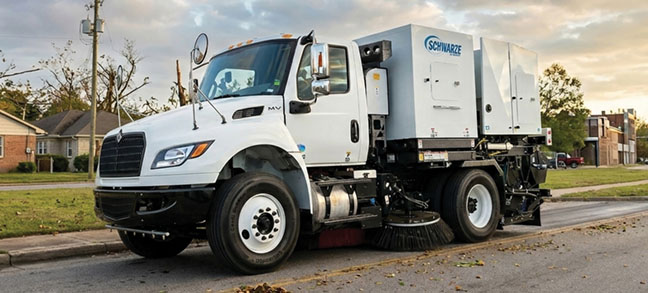
From Shop Floor to Street
By Maxx Hendriks
Sweeping season doesn’t start when the truck leaves the yard. It begins the moment preventive maintenance wraps up, and the fleet transitions from inspection mode to production mode. For municipalities, contractors, DOT crews, and construction teams, this is the critical window where preparation determines uptime, productivity, and compliance for the months ahead.
Once maintenance is complete, the focus shifts to three operational pillars: matching the right sweeper to the job, ensuring parts and consumables are staged for rapid response, and implementing disciplined inspection routines between jobs. When these elements are aligned, sweeping programs run efficiently and consistently, whether the assignment is curb-and-gutter maintenance, stormwater BMP compliance, or milling cleanup.
Match the Machine to the Mission
Not all sweeping applications are created equal. The industry has evolved beyond “if it looks clean, it is clean.” As environmental scrutiny has intensified, especially around stormwater and particulate control, equipment selection now plays a direct role in regulatory compliance and public health.
An overview of sweeping technology underscores why application fit matters.
Mechanical broom sweepers remain the standard for heavy, compacted material such as millings and spring sand. They excel in high-volume, abrasive conditions but are limited in their ability to remove fine, pollution-laden particles.
Vacuum and regenerative air systems, by contrast, bring different strengths to the table. Regenerative air systems, in particular, use a closed-loop blast-and-suction process that captures smaller micron particles across the full width of the sweeping head. This makes them highly effective where stormwater runoff, total suspended solids (TSS), and air-quality concerns are present.
Before sweeping season ramps up, fleet managers should review their deployment matrix:
• Municipal curb and gutter: Focus on small-particle removal and consistent edge cleaning.
• Downtown and city centers: Balance maneuverability with debris diversity, including paper, leaves, and grit.
• Highway and DOT work: Consider wider cleaning paths and durability under higher speeds.
• Milling and construction track-out: Prioritize mechanical durability and material-handling capacity.
Using the wrong machine increases wear, reduces performance, and can create compliance gaps. The right machine improves productivity while protecting components from unnecessary strain.
High-Dump Sweepers and Productivity Gains
Hopper configuration also plays a major role in efficiency. High-dump sweepers allow operators to unload debris directly into dump trucks, containers, or bins without leaving the jobsite.
This capability significantly boosts productivity on high-debris projects or sites with long haul distances. Construction cleanup, milling operations, airports, and large municipal programs benefit most. Instead of pausing to dump, crews can transfer material into nearby support trucks and keep sweeping continuously.
High-dump systems also simplify jobsite logistics. On milling and track-out jobs, debris can be loaded directly into haul trucks already in the workflow, reducing traffic, improving organization, and keeping work zones safer and more efficient.
Stock the Shelves Before the Demand Spikes
Even the best-prepared sweeper will experience wear and tear. The question is not if parts will need replacement, but whether they will be available when required.
One of the largest contributors to downtime is delayed procurement of parts. OEM components are engineered to meet exact specifications and are tested as part of an integrated system. Ill-fitting aftermarket components may introduce vibration, premature wear, or misalignment.
Fitment accuracy, material quality, warranty protection, and reliable distribution channels all influence uptime. For seasonal readiness, that translates into a simple operational directive: stock critical wear items before demand spikes.
Recommended Preseason Inventory
• Gutter broom segments (wire and poly)
• Main broom sections (for mechanical sweepers)
• Intake and fan seals
• Flaps and skirts
• Conveyor components (mechanicals)
• Filters (engine, hydraulic, and air systems)
• Belts and tensioners
• Bearings and skid shoes
• Hydraulic hoses and fittings
• Water spray nozzles
Filters deserve special attention. They protect high-value components and directly impact engine and hydraulic longevity. Using tested, properly specified components reduces the risk of secondary damage.
Downtime during peak sweeping months—spring cleanup, post-construction activity, or pre-rainfall BMP cycles—can cost far more than the price difference between OEM and will-fit components.
Lock in Preventive Maintenance Discipline
Completing preseason service is only the starting point. Equipment reliability throughout the season depends on maintaining consistent preventive maintenance practices.
Many mechanical problems develop gradually. Loose hardware, seal wear, misalignment, and vibration rarely appear suddenly; they emerge over time and can go unnoticed without routine inspections.
Common preseason focus areas include:
• Fan and intake seals: Dried or shrunken seals reduce air performance and create efficiency losses.
• Sweeping head adjustment: Proper spring tension allows the head to float rather than drag, preserving flaps and skids while improving pickup.
• Skid rotation: Uneven wear shortens service life; rotation extends it.
• Belt tension and bolt torque: Excess vibration often traces back to loose belts or fasteners.
Beyond structural checks, lubrication is foundational. Following the greasing schedule prevents premature bearing failure. Over-greasing is just as harmful as under-greasing and accounts for a significant portion of bearing issues. Correct grease selection and clean fittings are non-negotiable.
Lubrication isn’t a once-a-season activity; it is a continuous discipline that supports uptime throughout the calendar.
Inspect Between Every Job
One of the most overlooked components of readiness is the post-sweep inspection. Too many machines are “rode hard and put away wet.” The result is cumulative degradation.
Developing a consistent routine—before, during, and after each assignment—helps identify problems early.
Between jobs, operators should:
• Wash down and remove corrosive debris
• Inspect flaps and skirts for seal integrity
• Check broom wear and adjust as necessary
• Look for hydraulic leaks
• Verify lighting and safety systems
• Note performance changes or unusual vibration
Many organizations improve accountability by establishing a designated “return area” and “ready area.” This ensures every machine is inspected before returning to service.
When operators take ownership of their equipment, fleets typically experience better reliability and fewer mechanical failures.
Don’t Overlook Environmental Timing
Sweeping season is not only about debris volume; it’s about environmental timing. Fine particulate matter may be invisible, but its impact is measurable. When rain arrives, small-micron particles become total suspended solids in stormwater systems.
Regenerative air systems are widely recognized for their efficiency in removing these smaller particles across the entire sweeping head. For municipalities operating under NPDES permits, aligning sweeping schedules with rainfall patterns can maximize pollutant capture.
Readiness therefore, includes:
• Confirming the appropriate technology for stormwater BMP compliance
• Ensuring storage practices prevent reintroduction of fine material into runoff areas
• Maintaining consistent sweeping intervals appropriate to climate and traffic patterns
Sweeping is no longer cosmetic. It is an environmental control measure.
Maxx Hendriks is Marketing Generalist for Schwarze Industries LLC. He can be reached at mhendriks@schwarze.com