Does crack sealing actually work? Here’s what the research shows.
By Patrick Yeagle
Time is always at a premium for pavement professionals. If you’re just sealcoating a lot or chip sealing a road, why spend extra time addressing cracks? It’s all going to be covered when you’re done anyway.
But looks can be deceiving. A pristine surface treatment can conceal festering problems that may ruin both pavements and reputations. When you’re building for the long haul, a little time spent up front is an investment in the future.
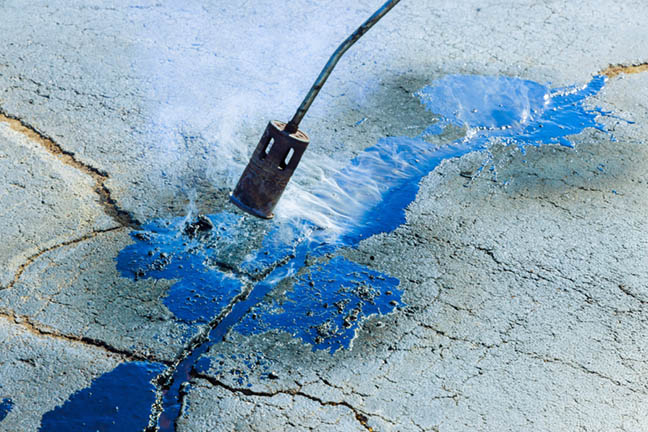
Cracking is one of the main ways asphalt deteriorates. Untreated cracks allow moisture into the pavement structure, which can lead to erosion and freeze-thaw damage. Cracks in the wheel path are prone to becoming potholes as tires break apart the edges of the crack. Incompressible debris can further destroy pavement as cracks widen and narrow with the seasons. Sealing asphalt cracks prevents these modes of deterioration, helping preserve the integrity of the pavement.
That has been proven time and time again by DOTs and researchers in real-world tests examining the efficacy of crack sealing. Here are highlights from some of that research.
NCAT & MnRoad, 2000–Present
In the thick southern pine forests outside Auburn, Alabama, lies an asphalt road that ends at an asphalt plant and rock quarry. Trucks going in are empty, but trucks leaving are typically loaded with stone. Since 2012, that unique traffic pattern has provided a perfect test lab for researchers studying crack sealing at the National Center for Asphalt Technology (NCAT).
It’s one of many study topics for NCAT and its sister project, MnRoad in Minnesota, where similar cold-climate research is underway. Data from these tests shows that crack sealing is a cost-effective way to extend pavement service life by as much as 7.5 years. NCAT also showed that sealing cracks on roads in good condition reduced the appearance of new cracks by about 50 percent compared with untreated control sections.
Six years after treatment, the test section that received both crack sealing and chip sealing still had not deteriorated to the condition it was in before treatment. Crack sealing provided the lion’s share of the benefit: the section that received only chip sealing formed about 12 percent more cracks than before treatment, while the combined treatment section had formed about 8 percent fewer cracks than before treatment.
But there’s a catch: you can’t wait until the pavement is already in poor condition. NCAT’s data shows that the worse the condition of a pavement section before treatment, the less crack-reducing benefit it will receive from sealing existing cracks.
Sealing cracks while the pavement is still in good to fair condition means more years before the pavement deteriorates to poor condition. Put simply, the farther out you can push that final state of deterioration, the more value you get out of the pavement. Sealing cracks early also uses less sealant, reducing project costs and maximizing long-term savings.
SHRP H106, 1991–1999
So what’s the best crack-sealing method to ensure long-term performance and maximum pavement life?
During the 1990s, the Federal Highway Administration conducted a multi-site experiment across the U.S. and Canada, testing different crack-filling and sealing methods in a combination of hot, cold, dry, and wet climates.
The study showed that routing, cleaning, and then sealing cracks provides the best sealant longevity.
When cracks were treated with a simple “band-aid” of sealant over the top, the sealant lasted 44.5 months on average. By comparison, when cracks were routed and then flush-filled, the sealant lasted 70 months. Adding a band-aid over the reservoir extended sealant life to 94.5 months — nearly eight years.
Why does routing make such a difference?
First, it prevents adhesion loss by creating a uniform bonding surface. Meandering crack widths can lead to differing tensile strain along the length of the crack, while loose material can inhibit a strong bond.
Second, routing creates a reservoir for the sealant. In hot summer months, pavement cracks narrow, squeezing the sealant above the surface where it is worn away by passing vehicles. When an unrouted crack widens again in cold weather, the remaining sealant may stretch beyond its elastic limit and fail. A routed crack, however, retains enough sealant in its reservoir to compensate for the widening gap.
Heating the sealant to the proper application temperature is also crucial. Sealant that is too cold may not have all its components activated, while overheating can degrade performance characteristics. The optimal approach is using materials and equipment designed to work together, ensuring temperature accuracy and maximizing performance.
The studies highlighted here are only two examples of the numerous research efforts undertaken to establish best practices at the local, state, and federal levels, as well as among academic and industry groups. Every advancement saves money, time, labor, frustration — and sometimes even lives.
When the job is done right, you can take pride in knowing it will last, and your customers or constituents will appreciate the difference.
Patrick Yeagle is a Content Marketing Specialist with Crafco, Inc. He can be reached at Patrick.Yeagle@crafco.com